
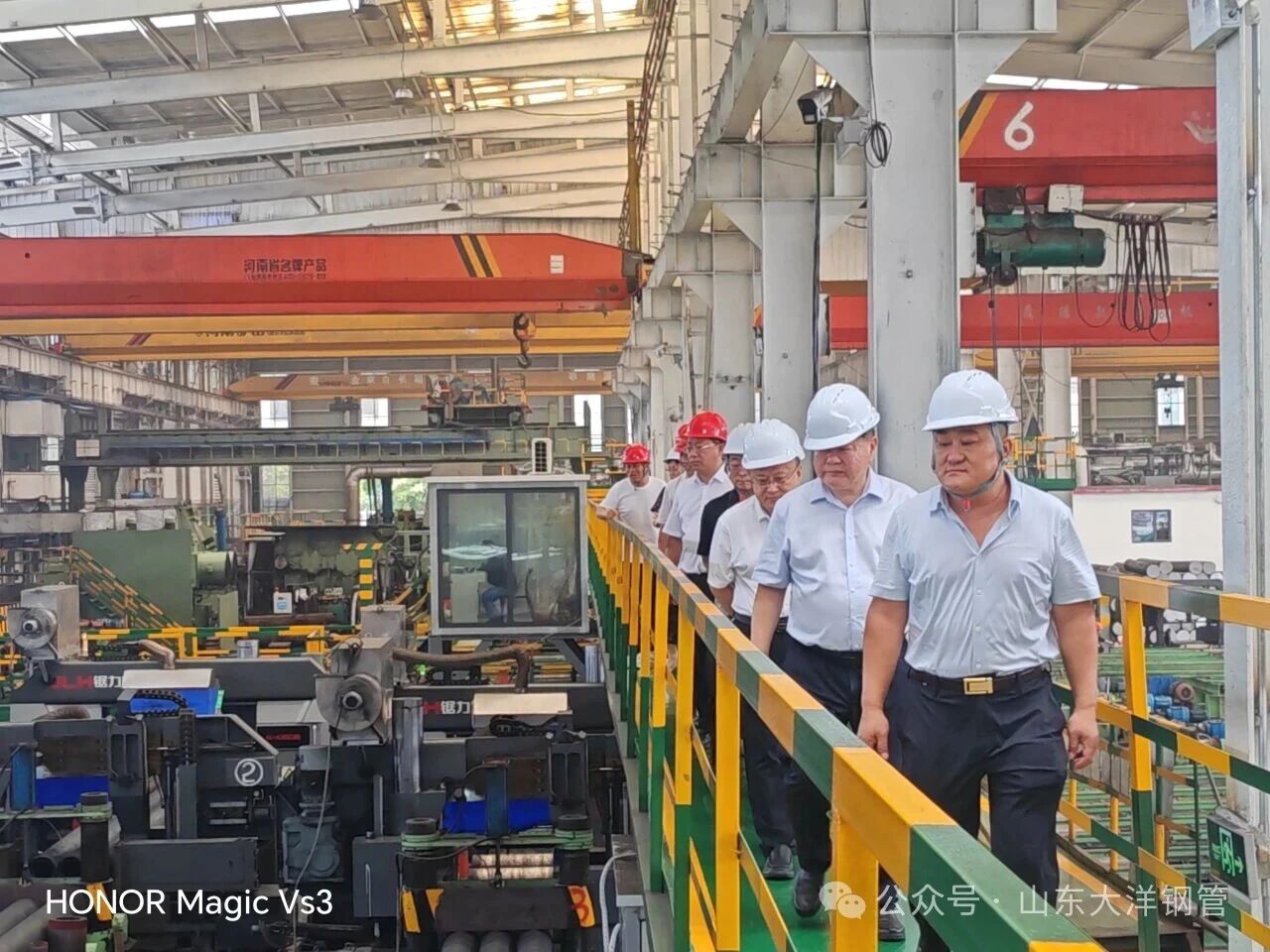
To further advance the high-quality development of the ferrous metal processing industrial chain, gain a clear understanding of industrial fundamentals, identify development weaknesses, and connect supply and demand chains, the Deputy Secretary of the Party Leadership Group and Deputy Director of the Standing Committee of the Municipal People’s Congress led a team consisting of relevant departments, key enterprises in the industrial chain and industry representatives to Dayang Group for the “Industrial Chain Inspection” activity of the ferrous metal processing industrial chain.
During the activity, the research group visited the enterprise’s production workshops, R&D center, product exhibition area and supporting project sites successively, and learned in detail about its production and operation, technological research and development, marketing, industrial chain supporting conditions as well as practical difficulties currently encountered. At every stop, the research group held in-depth exchanges with enterprise executives, listened carefully to briefings on raw material supply, capacity utilization, product upgrading, environmental protection and energy consumption, capital guarantee and other matters, and coordinated relevant departments on-site to respond to the issues raised by the enterprise.
At the forum held afterwards, the research group conducted in-depth discussions on the development status, industrial layout, collaborative supporting capacity, transformation and upgrading, and future plans of the ferrous metal processing industrial chain. It was pointed out at the meeting that the ferrous metal processing industry serves as an important pillar sustaining the steady growth of local industrial economy and a key sector for improving the quality and efficiency of manufacturing industry. We should adhere to the problem-oriented and goal-oriented approach, strengthen industrial chain thinking, drive coordinated development of upstream and downstream enterprises, and accelerate the formation of a more sound industrial ecosystem.
The meeting stressed that we should further consolidate the principal role of enterprises, support them to increase investment in technological transformation and innovation, and raise product added value and market competitiveness. We need to enhance inter-departmental coordination, focus on widely-concerned issues raised by enterprises including land use, energy consumption, financing, logistics and environmental protection, and establish a list-based closed-loop working mechanism. We should actively build supply-demand matching platforms centering on key links of the industrial chain to boost integrated development of large, medium and small enterprises. We must adhere to the green and low-carbon development path, and advance the transformation of the ferrous metal processing industry toward refinement, intellectualization and green development.
Person-in-charges of relevant departments stated that they will take this “Industrial Chain Inspection” activity of the ferrous metal processing industrial chain as an important opportunity to comprehensively sort out enterprise demands and industrial bottlenecks collected during the visits and surveys. They will set up problem ledgers, refine responsibility allocation and clarify handling time limits, and keep following up on various development needs of enterprises.
Authorities will provide proactive, targeted and regular on-site services to remove obstacles in the “last mile” of policy implementation, and help enterprises resolve difficulties in factor guarantee, market expansion, technical cooperation, environmental improvement and other fields.
Practical outcomes from this inspection will be translated into concrete measures to break development bottlenecks, fuel industrial upgrading and improve the quality and efficiency of the real economy. Efforts will continue to optimize the industrial development environment, offering solid support for extending, supplementing and strengthening the city’s ferrous metal processing industrial chain and achieving higher-quality development.